

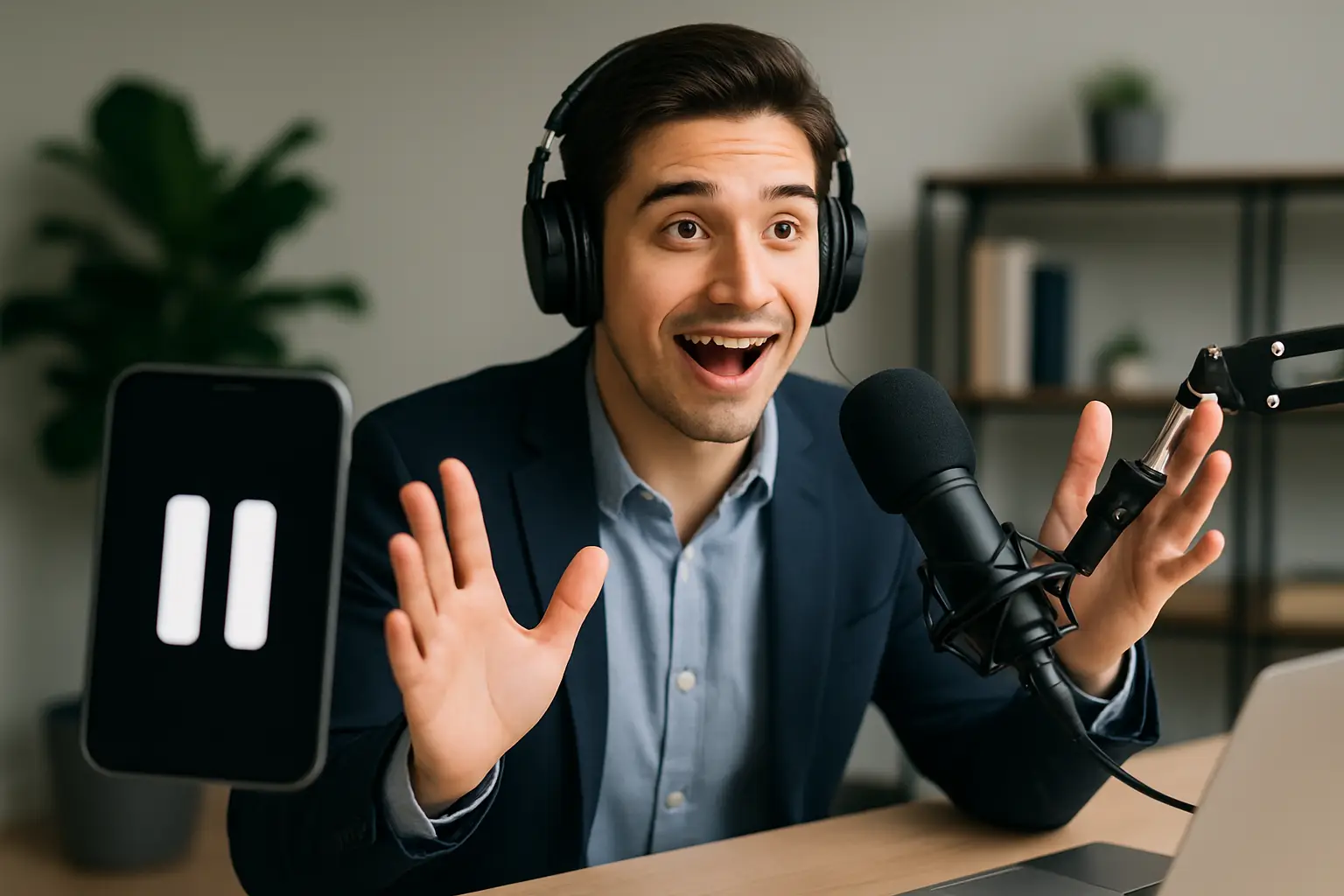
Your listener’s thumb is already hovering over the 15-second skip button.
That’s the real start of your episode. Not your music bed. Not your welcome line. The moment someone decides whether you sound like a confident guide or like background noise.
This is why your intro hook is not “nice to have.” It’s a retention device. It’s a promise about what kind of payoff they’ll get if they stay. Below are practical podcast intro hook examples you can use as written, plus the mechanics that make them work so you can keep writing new ones without sounding like you’re copy-pasting.
What a podcast intro hook actually does
A hook is a micro-contract. In the first 5-20 seconds, you’re answering three questions your listener is asking silently:
Who is this for? What’s the tension? Why should I trust you to deliver?
Great hooks create forward motion. They don’t just introduce the topic. They introduce an outcome and a reason to keep listening. That reason can be curiosity (an open loop), stakes (what’s at risk), identity (this is for people like me), or specificity (this is not generic advice).
Trade-off: the more aggressive the hook, the more you need to deliver. If you open with a shocking claim, then wander into housekeeping for 60 seconds, you’re training your audience to distrust you. Hooks raise expectations. Your job is to cash the check.
How to choose the right hook type
Pick your hook based on your episode format and your listener’s pain.
If you run interviews, you need a hook that frames the guest through a result, not a bio. If you teach, you need a hook that makes the lesson feel urgent and concrete. If you tell stories, you need a hook that plants a question and withholds the answer.
A simple rule: match the hook to the payoff.
- If the payoff is a step-by-step method, lead with a clear outcome.
- If the payoff is insight, lead with a counterintuitive truth.
- If the payoff is narrative, lead with a moment of friction.
Podcast intro hook examples (with quick notes)
Use these as scripts. Swap in your specifics. Keep the sentence length tight. One breath per line.
1) The cold-open moment
“By the time I hung up, I’d lost $12,000 – and it was entirely my fault.”
This works when your episode explains a mistake, turnaround, or lesson learned. You’re dropping the listener into action before context. Context comes after they’re emotionally invested.
2) The outcome-first promise
“In the next 10 minutes, you’ll have a one-page episode outline you can reuse forever.”
Outcome hooks are blunt and effective for educational shows. The discipline is delivering exactly what you promised, fast.
3) The contrarian slap
“Most podcast advice about ‘being yourself’ is why your intros drag.”
Contrarian hooks buy attention, but they also create defensiveness. Follow with a fair explanation, not a rant.
4) The uncomfortable question
“What would happen to your downloads if you cut your intro in half?”
Questions invite participation. Use them when you want the listener to self-diagnose.
5) The specific number
“Your first 30 seconds decide whether 40% of new listeners ever come back.”
Specificity signals competence. If it’s a rough estimate, phrase it honestly: “in my tests,” “for many shows,” or “often.”
6) The myth-buster
“You don’t need better mic settings. You need a better first sentence.”
This reframes the problem. It’s strong for creators who keep trying gear fixes for story problems.
7) The before-after snapshot
“Two months ago, my episodes averaged 18 minutes of listening. Today they average 31. Here’s the one change.”
This is a credibility hook. It’s not bragging if you teach the method and acknowledge what might differ for their show.
8) The high-stakes warning
“If you open with a long welcome, you’re paying a retention tax every episode.”
Warnings create urgency. Back it up with a reason and a fix.
9) The micro-story teaser
“Three emails. One misunderstood sentence. And a client who almost quit.”
This is the simplest narrative device: setup without resolution. The listener stays for the missing piece.
10) The “here’s what you’ll steal” hook
“I’m going to give you three hook templates I use when an episode feels flat.”
This is practical and honest. It’s also a commitment device – now you must deliver three.
11) The identity call-out
“If you’re a solo host who feels pressure to ‘sound energetic,’ this will make your intros easier.”
Identity hooks reduce friction because the listener feels seen. Don’t over-niche unless your content truly serves that niche.
12) The stakes-for-them frame
“This episode will save you from recording great content that nobody finishes.”
That line names the real enemy: drop-off. It’s a retention-focused promise.
13) The “you’re probably doing this” pattern interrupt
“You’re about to hear the most common intro mistake – and you might not notice it until I point it out.”
This creates curiosity and a test. People love to see if they’re guilty.
14) The audio texture hook (use sound deliberately)
[Two seconds of silence] “That silence? That’s where most hosts lose people.”
You’re using the medium, not just talking about it. Keep it clean – don’t do gimmicky effects that don’t connect to the lesson.
15) The bold claim with a deadline
“You can write a stronger intro in five minutes than you wrote in the last five hours.”
Big claims work when followed by a clear process. If you can’t back it up, soften it.
16) The “I’ll prove it” hook
“I’m going to play two intros – one that bleeds listeners and one that holds them. You’ll hear the difference.”
Proof hooks are excellent for teaching shows because they promise evidence, not opinions.
17) The curiosity gap with a concrete object
“I have a sticky note on my monitor that fixes 80% of my intro problems. I’ll read it to you in a minute.”
Objects create visual anchors in audio. The “in a minute” is an open loop – but pay it off quickly.
18) The empathetic confession
“I used to waste the first minute trying to ‘warm up.’ It was killing my show.”
Confession hooks build trust, especially for beginners. The trick is to pivot immediately into the fix.
19) The “today you’ll decide” hook
“By the end of this episode, you’ll know whether your show should use a cold open or a narrated teaser.”
Decision hooks work when your episode helps listeners choose between two approaches.
20) The guest-as-a-result (for interviews)
“Today’s guest turned a two-person newsletter into a seven-figure business – without paid ads. Here’s how they think.”
This is how you frame an interview: outcome and angle, not resume.
21) The “one sentence you need” hook
“If you only fix one line in your intro, fix this one: your promise.”
This sets up a focused, high-leverage lesson. Perfect for short episodes.
The hook-writing mechanics you can reuse
You don’t need endless inspiration. You need repeatable levers.
Write the hook after you outline the payoff
Most weak hooks come from writing the opening before you know the episode’s real shape. Outline first. Decide the payoff sentence – the one your listener will repeat to a friend. Then build the hook to point directly at that payoff.
If your episode has multiple points, pick one hero outcome for the intro. You can layer in secondary benefits later, but the opening needs a single target.
Tighten to one promise, one tension
A hook bloats when you stack promises: “We’ll talk about mindset, strategy, tools, and my story…” That’s not a hook, it’s a table of contents.
Instead, choose one promise and one tension.
Promise: what they get. Tension: what makes them need it now (a mistake, a myth, a risk, a deadline, a common pain).
Avoid “podcast voice” and start on verbs
Openings die when you start with filler: “Welcome back,” “I’m so excited,” “Today we’re talking about…” You can still greet people, but earn that greeting after you’ve earned attention.
A simple fix: begin with an action verb or a consequence. “Stop doing this.” “Here’s what it costs.” “Listen to this.” “Picture this.”
Pay off the open loop fast
Open loops are powerful, but only if you resolve them before the listener feels manipulated. If you tease a story, give them the missing key within the first 2-3 minutes, then continue the deeper lesson.
Think of it like interest: the longer you hold the payoff, the more you owe.
A quick way to test your intro before you publish
Read your first 20 seconds out loud and ask two questions.
First: would a stranger know what this episode does for them? Second: did you create forward motion, or did you just start talking?
If you want a tighter system for scripting openings and controlling pacing across the whole episode, that’s the lane we teach at Lupa Digital – narrative discipline with retention as the scoreboard.
Your hook doesn’t need to be loud. It needs to be precise. Write the promise like you mean it, put tension in the first breath, and treat the Golden Minute like a competitive arena where attention is earned, not granted.

Arthur Zani is a podcast storytelling enthusiast who helps beginner podcasters turn simple ideas into engaging audio stories. With a strong focus on clarity, emotion, and listener connection, they share practical tips and insights to help new creators build confidence, improve retention, and tell stories that truly resonate.