

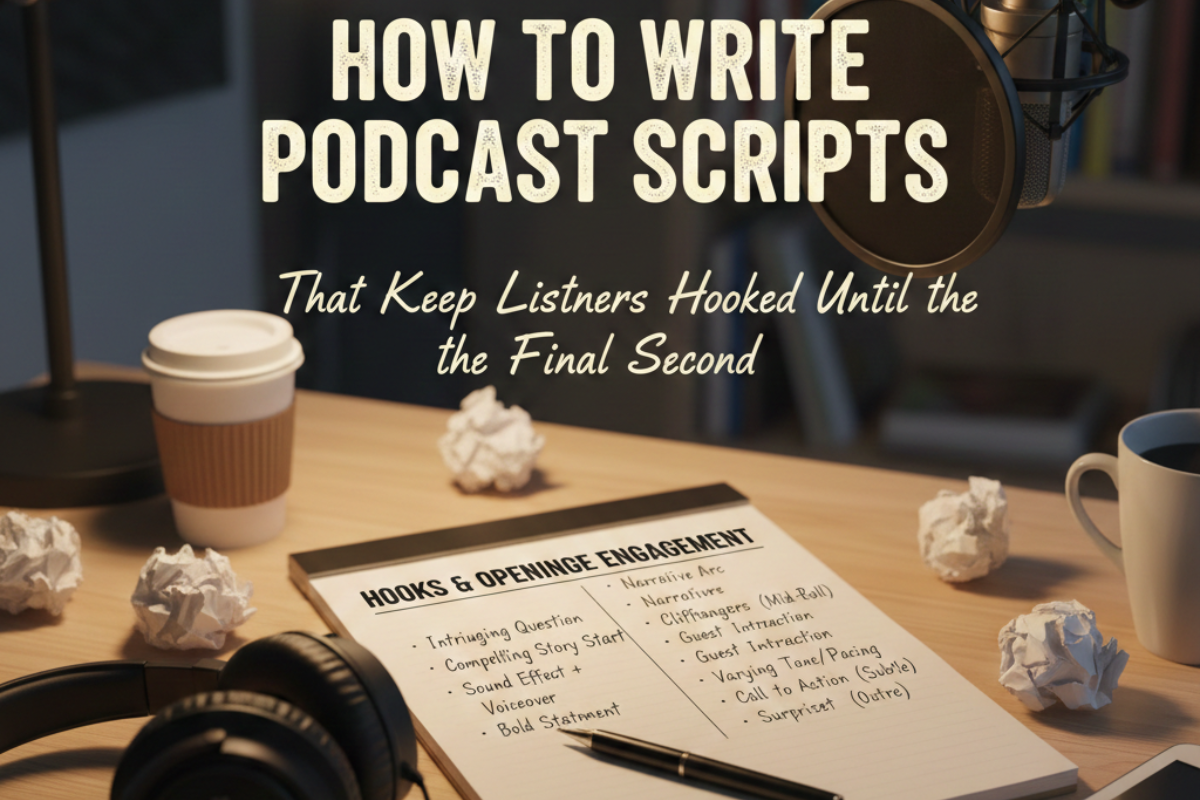
In the golden age of podcasting, where over 460 million people worldwide tune into their favorite shows, the competition for listener attention has never been fiercer. While anyone can start a podcast with minimal equipment, creating content that captivates audiences from the opening seconds to the final outro requires masterful scripting skills. The difference between podcasts that build devoted followings and those that fade into obscurity often comes down to one critical factor: the quality and structure of the script.
Whether you’re producing a true crime series, an educational show, a business podcast, or an entertainment program, understanding the art and science of podcast scriptwriting can transform your content from forgettable to unforgettable. This comprehensive guide will explore proven strategies, techniques, and frameworks that professional podcasters use to keep listeners engaged until the very last second.
Understanding the Unique Nature of Audio Scripting
Before diving into specific techniques, it’s essential to recognize that podcast scripts differ fundamentally from other writing formats. Unlike blog posts where readers can skim, or videos where visual elements supplement content, podcasts rely exclusively on audio to convey information and maintain engagement. This creates unique challenges and opportunities.
Listeners typically consume podcasts while multitasking—commuting, exercising, cooking, or working. This means your script must be compelling enough to hold attention despite competing stimuli, yet clear enough to be understood without visual aids. The writing must sound natural when spoken aloud, avoiding complex sentence structures that work on paper but become confusing when heard.
Additionally, listeners can’t easily reference previous information or skip ahead to see where you’re going. Your script must create a linear journey that builds logically while maintaining momentum, with strategic repetition of key points to ensure comprehension without sounding redundant.
Crafting Irresistible Openings That Hook Immediately
The first thirty seconds of your podcast episode may be the most critical. Research shows that the majority of listener drop-off occurs within the first few minutes, making your opening the make-or-break moment that determines whether someone stays or leaves.
Effective podcast openings employ several proven techniques. The cold open or “in medias res” approach drops listeners directly into the most compelling moment of your episode before any introductions. Imagine starting a business podcast with: “The email that destroyed his company arrived at 3:47 AM on a Tuesday. By noon, everything he’d built over fifteen years was gone.” This technique creates immediate intrigue and investment before you’ve even introduced yourself or the topic.
Another powerful approach is the provocative question or statement that challenges assumptions or promises valuable insights. Opening with “Everything you think you know about productivity is probably making you less efficient” immediately engages listeners who care about productivity by creating cognitive dissonance that demands resolution.
The personal anecdote opening creates connection through vulnerability and relatability. Sharing a brief, relevant personal story that connects to your episode’s theme helps listeners see you as a real person rather than a disembodied voice, fostering the intimacy that makes podcasting such a powerful medium.
Regardless of which opening style you choose, the key is getting to the point quickly. Avoid lengthy introductions about yourself, excessive sponsor reads before providing value, or meandering preambles that test patience. Your opening should clearly communicate what listeners will gain by staying and why it matters to them specifically.
Structuring Your Script for Maximum Engagement
The overall architecture of your script determines whether listeners remain engaged throughout or gradually lose interest. Professional podcast scripts typically follow proven structural frameworks that create natural momentum and satisfaction.
The three-act structure, borrowed from storytelling traditions, divides your episode into setup, confrontation, and resolution. The first act establishes context and stakes, the second act explores complexity and challenges, and the third act provides synthesis and takeaways. This structure satisfies our innate human desire for narrative coherence while preventing the aimless rambling that plagues poorly structured podcasts.
For educational or informational content, the problem-agitation-solution framework works exceptionally well. Begin by identifying a problem your audience faces, agitate it by exploring why it matters and what happens if unaddressed, then provide your solution or insights. This structure maintains engagement by creating tension that demands resolution.
The modular approach breaks your episode into distinct segments or chapters, each with its own mini-arc. This technique works particularly well for longer episodes, providing natural breathing points while maintaining overall cohesion. Clear transitions between segments help listeners track progress and create anticipation for what’s coming next.
Regardless of structure, your script should include strategic “commitment points”—moments that reward listeners for staying while promising more value ahead. These might be particularly insightful revelations, surprising statistics, or teasers for upcoming content. Spaced throughout your episode, these commitment points continuously renew listeners’ motivation to keep listening.
Writing for the Ear, Not the Eye
The single most common mistake in podcast scripting is writing for readers rather than listeners. Text that looks perfect on paper often sounds stilted, overly formal, or confusing when spoken aloud. Mastering the distinction between written and spoken language is essential for creating scripts that flow naturally.
Conversational language uses contractions, shorter sentences, and everyday vocabulary. Instead of writing “It is important to understand that successful podcasting requires consistent effort,” write “Here’s the thing—great podcasts don’t happen by accident. They take consistent work.” The second version sounds like natural speech and creates a more intimate connection with listeners.
Rhythm and pacing matter enormously in audio content. Varying sentence length creates natural cadence that maintains interest. Short sentences create impact and emphasis. Longer sentences allow for exploration of complex ideas while maintaining flow through careful clause construction. Reading your script aloud during the writing process helps identify awkward phrasing, tongue-twisters, or passages that feel rushed or dragging.
Strategic repetition reinforces key concepts without boring listeners. Unlike written content where readers can reference previous paragraphs, audio requires gentle repetition of important ideas using varied language. Techniques like “As I mentioned earlier,” “Remember when we talked about,” or simply restating concepts in different contexts ensure comprehension without insulting intelligence.
Transitional phrases guide listeners through your content, signaling shifts in topic, perspective, or tone. Phrases like “Now, here’s where it gets interesting,” “But there’s another side to this,” or “Let me give you an example” create mental waypoints that prevent listeners from feeling lost in a stream of information.
Creating Compelling Characters and Narratives
Even podcasts that aren’t explicitly storytelling benefit enormously from narrative techniques and character development. Humans are hardwired to respond to stories and personalities, making narrative elements powerful tools for maintaining engagement.
When discussing concepts, case studies, or examples, frame them as mini-stories with characters facing challenges and making decisions. Instead of presenting dry statistics about business failure rates, tell the story of a specific entrepreneur whose decisions led to failure or success. This transformation from abstract to concrete, from data to human experience, creates emotional investment that pure information cannot.
Your own voice and personality are characters in your podcast narrative. Developing a consistent on-air persona that feels authentic while being intentionally crafted helps listeners form parasocial relationships with you. This doesn’t mean being fake—rather, it means being the best, most engaging version of yourself, emphasizing aspects of your personality that serve your content and audience.
For interview-based podcasts, your script should frame guests as interesting characters with unique perspectives rather than simply sources of information. Pre-interview research allows you to craft questions that reveal personality, motivation, and story alongside expertise, creating multidimensional portraits that captivate listeners.
Mastering the Art of Pacing and Momentum
Pacing—the speed at which your content unfolds—directly impacts listener engagement. Too slow, and attention wanders; too fast, and listeners feel overwhelmed. Masterful scripts modulate pacing strategically throughout the episode.
Information density should vary throughout your episode. Dense, complex segments require slower pacing with more explanation and examples, while lighter content can move more quickly. Alternating between these creates natural rhythm that prevents fatigue while ensuring comprehension.
Strategic pauses, written into your script as “[pause]” or “…” give listeners time to process important information and create emphasis. After posing a provocative question, a brief pause allows it to resonate before you provide the answer. After sharing a surprising fact, a pause lets its impact register.
Momentum techniques keep listeners moving forward through your content. Teasing upcoming content (“In a few minutes, I’ll share the surprising research that changed my entire perspective”), creating cliffhangers before breaks (“But what happened next shocked everyone involved—we’ll get to that after this quick message”), and using forward-looking language (“As we’ll see,” “Coming up,” “Later in this episode”) all create anticipation that discourages dropping off.
The energy level in your script should build toward key moments rather than remaining flat throughout. Identify the climax or most important revelation in your episode and structure surrounding content to build toward it, creating a crescendo that provides satisfaction and payoff.
Incorporating Research and Evidence Effectively
Credibility matters in podcasting, and well-researched content builds authority and trust. However, presenting research in your script requires finesse to maintain engagement while establishing credibility.
Statistics and data points should be presented sparingly and with context that makes them meaningful. Rather than rattling off numbers, transform them into relatable comparisons. Instead of “73% of marketers,” say “Nearly three out of every four marketers.” Instead of “The company lost $4.2 million,” say “The company lost enough money to fund 84 average American households for an entire year.”
Source attribution builds credibility without disrupting flow. Phrases like “According to research from Stanford University,” “As reported in the Journal of Applied Psychology,” or “Data from a recent McKinsey study shows” establish authority while maintaining conversational tone. However, avoid excessive citation that makes your podcast sound like an academic paper.
Expert quotes and interviews add variety and authority to your script. When incorporating pre-recorded interviews or quotes, write smooth transitions that introduce the speaker and context before the audio plays, then provide commentary or analysis afterward that synthesizes the information with your broader points.
Writing Effective Transitions and Segments
Professional podcast scripts move seamlessly between topics, segments, and ideas without jarring listeners or creating confusion. Mastering transitions is essential for maintaining the flow that keeps audiences engaged.
Thematic transitions connect new topics to previous content by highlighting relationships. “Now that we’ve explored why this problem exists, let’s look at potential solutions” creates logical progression. “This connects directly to what we discussed earlier about” reinforces continuity and helps listeners see the bigger picture.
Contrast transitions signal shifts in perspective or topic while maintaining engagement through variety. “But here’s the other side of this debate,” “Now, let’s flip this around,” or “Contrast that with” prepare listeners for new information while creating interest through juxtaposition.
Time-based transitions work well for narrative or chronological content. “Three months later,” “Meanwhile,” or “Before this happened” help listeners track temporal progression without confusion.
When incorporating sponsor segments, ad reads, or breaks, write transitions that don’t kill momentum. Rather than abruptly stopping content, create natural bridges: “Before I share that surprising discovery, I want to tell you about something that’s made my own work much easier” feels less jarring than simply inserting an ad.
Crafting Powerful Conclusions That Create Loyalty
While openings hook listeners, conclusions determine whether they return for the next episode. A strong ending provides satisfaction while creating anticipation for future content, transforming one-time listeners into loyal subscribers.
Effective conclusions synthesize key takeaways without simply repeating everything said earlier. Distill your episode into core insights or action items that listeners can immediately apply, providing clear value and justifying the time they invested.
The call-to-action in your conclusion should feel like a natural next step rather than a pushy sales pitch. Whether you’re asking listeners to subscribe, leave reviews, visit your website, or implement specific strategies, frame it as continuing the journey you’ve shared rather than an unrelated demand.
Forward-looking conclusions create anticipation for future episodes. Teasing upcoming topics, introducing questions you’ll explore next time, or revealing upcoming guests gives listeners specific reasons to return. “Next week, we’ll explore the surprising solution that top performers use” creates a cliffhanger that encourages subscription.
The emotional tone of your conclusion matters enormously. Ending on an inspiring note leaves listeners feeling energized and positive about your podcast. Ending with thought-provoking questions encourages continued reflection. Ending with gratitude for their time and attention reinforces the relationship you’re building.
Refining Through Editing and Testing
The first draft of your script is never the final version. Professional podcasters understand that ruthless editing transforms good scripts into great ones. After writing, step away from your script for at least a few hours before editing with fresh perspective.
Read your entire script aloud, timing yourself and noting where you stumble, where pacing feels off, or where language sounds awkward. This audio test reveals problems that silent reading misses. Record yourself reading the script and listen back as if you were a listener—where does your attention wander? What feels unclear or boring?
Cut ruthlessly. Every sentence should serve a purpose—advancing your argument, providing essential context, creating engagement, or building connection. If a section doesn’t accomplish these goals, delete it regardless of how clever or well-written it might be. Podcast scripts benefit from the “kill your darlings” principle perhaps more than any other medium.
Test your script with representative audience members before recording if possible. Their feedback on clarity, engagement, and pacing provides invaluable insights that help you refine content before committing to final production.
The Continuous Craft of Podcast Scripting
Writing podcast scripts that captivate listeners from beginning to end is both an art and a science—requiring creativity and structure, personality and professionalism, spontaneity and planning. The techniques explored in this guide provide a foundation, but mastery comes through consistent practice, experimentation, and refinement.
The most successful podcasters treat each script as an opportunity to improve their craft, analyzing what worked and what didn’t, studying podcasts they admire, and continuously evolving their approach. They understand that keeping listeners hooked until the final second isn’t about manipulation or gimmicks—it’s about respecting your audience’s time by delivering exceptional value in an engaging, well-structured format.
As you develop your scripting skills, remember that authenticity matters more than perfection. Your unique voice, perspective, and personality are what ultimately differentiate your podcast in a crowded market. Use these structural and technical tools to amplify your authentic self rather than obscure it, and you’ll create content that not only keeps listeners engaged but builds a devoted community that eagerly anticipates every new episode you release.
https://www.bcast.fm/blog/podcast-script-template

Arthur Zani is a podcast storytelling enthusiast who helps beginner podcasters turn simple ideas into engaging audio stories. With a strong focus on clarity, emotion, and listener connection, they share practical tips and insights to help new creators build confidence, improve retention, and tell stories that truly resonate.