

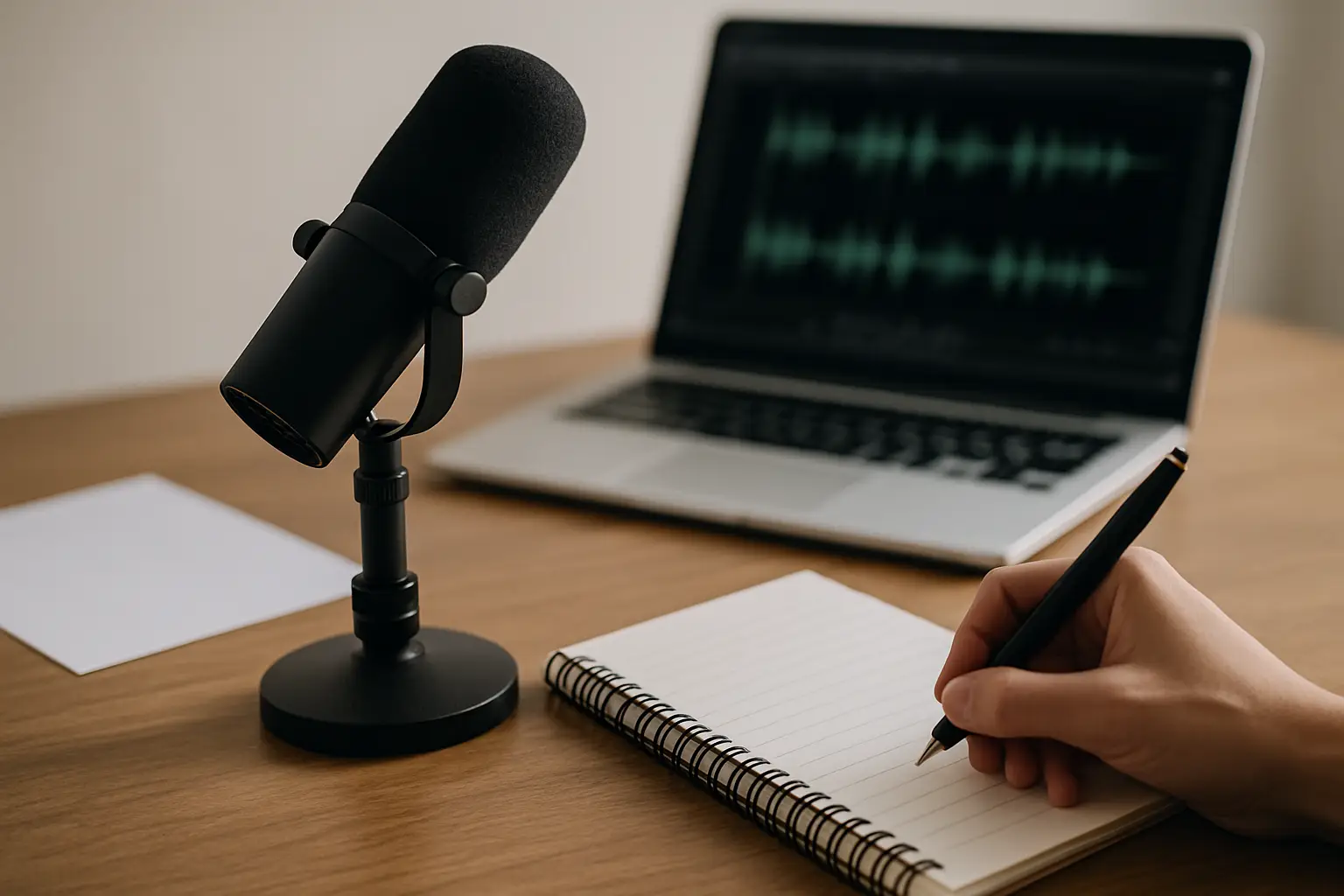
You can feel the exact second listeners start drifting. The intro keeps talking, the point hasn’t landed yet, and the episode is still clearing its throat. That moment is not a hosting problem. It’s a script problem.
If you want repeat listeners, you need repeatable narrative control. A podcast script is not a word-for-word prison. It’s a performance plan that protects pacing, makes your promises explicit, and builds momentum so people keep listening when distractions show up. Here’s how to write a podcast script that earns attention like it’s a scarce resource – because it is.
What a podcast script is (and what it isn’t)
A strong script does three jobs at once: it creates a clear promise, it shapes an emotional curve, and it makes the recording/editing process faster. That last part matters more than most creators admit. When your structure is tight, your delivery improves and your edit stops being a rescue mission.
What it isn’t: a transcript you hope sounds natural. If you write like an essay, you’ll perform like an essay. Audio needs forward motion, stakes, and clean signposts.
The trade-off is real. More scripting can reduce “hangout energy” in conversational shows. Less scripting can increase meandering and listener drop-off. Your goal is not maximum scripting. Your goal is the right amount of control for your format.
The two decisions that make scripting easy
Before you write a single line, lock in two decisions.
First: what’s the episode’s one-sentence payoff? If a listener asked, “Why should I care?”, can you answer in one sentence without adding clauses? Your payoff sentence is your north star. It becomes your opening promise, your section selection filter, and your ending.
Second: what format are you scripting for? A solo teaching episode needs different scaffolding than an interview. For solo, you script transitions, examples, and the “why now.” For interviews, you script stakes, framing, follow-ups, and the story spine – not every question.
Get these wrong and you’ll write more words and get less retention.
Start with the Golden Minute: hook, promise, path
The first 60 seconds are a battlefield. You’re not just introducing yourself. You’re making the case that this episode will pay off faster than whatever else is competing for the listener’s attention.
A high-performing opening usually contains three elements.
Hook: a specific tension, not a topic
“Today we’re talking about email marketing” is a topic. “Your open rates are fine, but your sales are flat – and the fix is probably in your last two lines” is tension. Tension creates curiosity. Curiosity buys you time.
Write your hook as a single, concrete statement or mini-story. If you need multiple sentences to make it interesting, you don’t have a hook yet.
Promise: what the listener will be able to do
Your promise should be outcome-based and time-bound when possible. “By the end of this, you’ll have a 3-part structure you can reuse for every episode intro” beats “we’ll cover some tips.”
Path: the roadmap that signals discipline
A short path lowers anxiety. People keep listening when they believe you have control. Give them the route in one breath: “We’ll build the hook, map the middle so it doesn’t sag, then write an ending that creates the next listen.”
When you script the Golden Minute, write it tighter than the rest. Record it last if you can. Once you know what the episode truly delivers, you can make an honest, sharper promise.
Build your episode spine before you write paragraphs
Most “script problems” are actually outline problems. If your outline has weak joints, your script will have weak pacing.
Think in scenes, even for non-fiction. Each segment should have a job: introduce a tension, deepen it, resolve it, or pivot the listener to the next question.
A simple, reliable spine for educational or business podcasts is:
- Problem and stakes
- The common mistake (why people get stuck)
- The framework or solution
- A worked example
- Implementation steps and a final push
You can adapt this to interviews by assigning these beats to the conversation: you’re still moving through tension to resolution. The listener doesn’t care that it’s an interview. They care that it’s going somewhere.
Write for the ear: shorter sentences, louder verbs
Once the spine is solid, scripting becomes mechanical. The rule is simple: write how people process audio.
Use shorter sentences than you think you need. Put the “point” at the front of the sentence, then justify it. Choose verbs that move: “cut,” “swap,” “start,” “show,” “prove.” Avoid abstract mush like “leverage” and “optimize” unless you define exactly what to do.
Read every section out loud while writing. If you run out of breath, your listener runs out of patience.
Script the transitions like a director
Transitions are where retention dies. Not because your content is bad, but because the listener’s brain loses the thread.
A great transition does two things: it closes the loop on what you just said and opens a new loop that pulls you forward. You’re basically saying, “That’s handled. Here’s the next thing you now need.”
Instead of “Now let’s talk about…” write transitions that create consequence:
If you just explained the mistake, the next line can be: “Once you see that, the fix is surprisingly simple – but only if you change the order of your next three minutes.”
That sentence is a bridge and a hook at the same time.
Add suspense without turning into a drama show
Suspense in podcasting isn’t spooky music. It’s controlled information. You delay the full answer long enough to make the listener lean in, but not so long that they feel manipulated.
Two practical ways to script suspense in educational content:
First, use open loops. Tease a payoff, then earn it: “In a minute, I’ll give you the exact sentence template. But first you need the rule that keeps it from sounding fake.”
Second, stack specificity. Start broad, then tighten: “Most intros fail because they explain. Better intros prove. Here’s what proving sounds like in 12 words.”
The trade-off: over-teasing erodes trust. If you promise a “template” and deliver a vague concept, you’ll train the listener to stop believing you.
Script your host voice, not your school voice
Many podcasters can teach, but they can’t sound like themselves while teaching. That’s a scripting choice.
Write your script in the voice you’d use with a smart friend who’s busy. Keep contractions. Use occasional fragments. Give yourself permission to sound human.
One trick: after drafting a section, rewrite it as if you’re answering a voicemail question. You’ll naturally cut fluff and add directness.
If you interview, script the story spine and the traps
Interview scripting is less about questions and more about outcomes. Write the episode like you’re producing a documentary: you need a beginning, escalation, and a landing.
Start with the arc you want: what should the listener believe or do by the end? Then script:
- Your opening framing (why this guest matters right now)
- Three “stakes” questions that surface tension early
- Follow-up prompts that prevent vague answers (“What did that look like on Tuesday?” “What did you do next?”)
- Two redirect lines for when the guest goes abstract (“Let’s anchor that in one example.”)
You’re not controlling the guest. You’re protecting the listener.
Write the ending first if your episodes tend to ramble
If your mid-sections sprawl, write your ending earlier than you want to. An ending acts like gravity. It pulls your choices into alignment.
A strong ending usually includes a decision point for the listener. Not “thanks for listening,” but a clear next action or perspective shift that changes behavior.
Try scripting an ending that does three things in under 20 seconds: restate the core payoff, name the most likely resistance, and push through it. That’s how you turn a good episode into a repeatable habit.
Build an edit-friendly script
A script isn’t just for recording. It’s for editing.
As you write, mark places where you want breath, emphasis, or a music sting if you use one. Write in short blocks that can be cut cleanly. Avoid paragraphs that contain five different ideas, because they’ll be impossible to trim without breaking logic.
Also script your “pickup lines” – short sentences you can re-record later to fix pacing or clarify a point. If you know you tend to rush transitions, write a clean bridge line that you can drop in during editing.
A simple workflow you can repeat every week
If you want consistency, you need a process that fits your schedule.
Draft your payoff sentence first. Then write the Golden Minute. Outline the spine in 5-7 segment beats. Only then write the actual lines, starting with transitions and section openers – the parts that control momentum. Record a rough take, listen back at 1.2x speed, and tighten any section where you get impatient with yourself.
That last step is uncomfortable and incredibly useful. If you’re bored, your listener is gone.
If you want more scripting mechanics like this organized into clear tracks, Lupa Digital builds its whole library around narrative control and retention-first episode craft.
The real goal: a script that makes the listener feel guided
When your script works, it doesn’t feel scripted. It feels inevitable. The listener senses a steady hand: you know where this is going, you’re not wasting their time, and every minute is doing a job.
The closing thought to keep on your desk: write like attention is expensive, then perform like you’re grateful you got it.

Arthur Zani is a podcast storytelling enthusiast who helps beginner podcasters turn simple ideas into engaging audio stories. With a strong focus on clarity, emotion, and listener connection, they share practical tips and insights to help new creators build confidence, improve retention, and tell stories that truly resonate.