

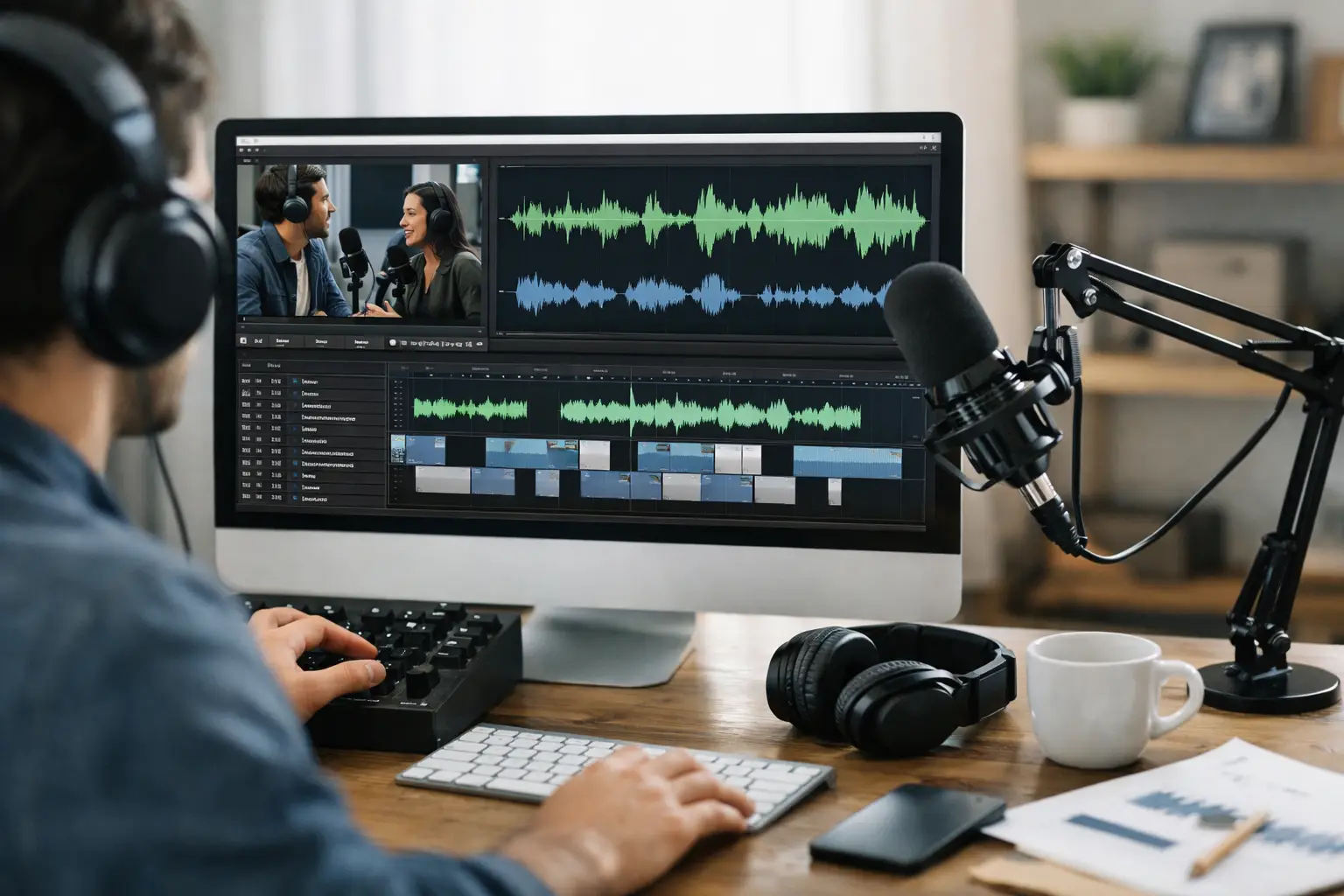
Most podcast edits fail before the first music cue. Not because the audio is noisy, but because the editor is treating the session like cleanup instead of story construction.
That distinction matters. If your goal is retention, editing is not the stage where you remove mistakes and tighten breaths. It is the stage where you decide what the listener feels next. Curiosity or boredom. Momentum or drift. Trust or confusion. Every cut either strengthens the episode’s narrative pull or weakens it.
If you want to know how to edit a podcast for storytelling, start here: stop asking, “What can I trim?” and start asking, “What is the listener being compelled to follow?”
What storytelling editing actually means
Storytelling edits shape attention. They arrange information, emotion, and timing so the episode creates forward motion. That can apply to true crime, interview shows, solo educational podcasts, business podcasts, and documentary-style series. You do not need a cinematic production to use narrative editing. You need control.
In practice, storytelling editing means you are making decisions based on sequence, stakes, clarity, and payoff. You are not just removing filler words. You are deciding where the question enters, when the answer is delayed, which detail earns emphasis, and how each scene or segment hands off to the next.
That is why technically clean audio can still perform badly. A polished but shapeless episode asks too much from the listener. They should not have to assemble the meaning for you.
How to edit a podcast for storytelling: start with the spine
Before you touch micro-edits, find the episode spine. This is the central narrative movement that holds the whole piece together. In a reported episode, that might be a problem moving toward resolution. In an interview, it may be the guest’s transformation. In an educational episode, it could be the listener moving from confusion to capability.
If you cannot say, in one sentence, what progression the episode follows, your edit will sprawl.
A useful test is this: what changes between minute one and the ending? If the answer is vague, the listener will feel that vagueness too.
Once you identify the spine, map the material against it. You will usually find three categories. Some moments drive the story forward. Some support it with context or texture. Some are merely interesting but pull energy away from the core movement. That last category is where many episodes lose retention. Strong editors cut good material to protect better material.
Build the opening around tension, not background
The opening is not where you warm up. It is the battlefield where attention is won or lost.
Many podcasters front-load context because they are trying to be helpful. But listeners do not stay because they received background information. They stay because they sense movement and want the next piece.
So when editing your opening, lead with tension first. That does not mean artificial drama. It means present a live question, a sharp contrast, an unresolved claim, or a moment of consequence before you explain the full setup.
If your raw tape begins with throat-clearing, broad framing, or generic host chatter, cut aggressively. Find the earliest moment where the episode starts making a promise.
Then shape the first minute around three jobs: establish what this is about, why it matters now, and what kind of payoff the listener will get if they keep going. If one of those is missing, the intro often feels flat.
Edit for sequence, not chronology
Raw recordings arrive in the order they happened. Good stories rarely stay in that order.
One of the most useful answers to how to edit a podcast for storytelling is this: chronology is optional, clarity is not. You can move clips, pull a revealing line forward, delay context, or restructure an interview answer if the result is more coherent and more compelling.
The trade-off is trust. If you reorder material, the meaning must remain honest. Do not create false causality or manufacture emotional reactions that were not there. But within ethical boundaries, sequence is a tool.
For example, if a guest spends three minutes circling before finally saying the sentence that captures the real conflict, open with that sentence. Then backfill what the listener needs. The edit should serve comprehension and momentum, not loyalty to the original timeline.
Cut for momentum, but protect breath
A common mistake among newer editors is cutting too little. A common mistake among more ambitious editors is cutting too much.
Yes, remove repetition, throat-clearing, and detours that dilute the point. But storytelling requires rhythm, and rhythm needs variation. If every pause disappears, every answer is compressed, and every transition is machine-tight, the episode can feel emotionally dead.
Listeners need processing time. They need contrast between fast sections and slower ones. They need emphasis to land. Sometimes a half-second pause after a revealing line does more for retention than another sentence of explanation.
This is where craft beats formula. A high-energy advice segment may benefit from tighter compression and brisk transitions. A vulnerable personal story may need more space. Pacing is not just about speed. It is about controlled release.
Use transitions to create handoffs, not traffic jams
Weak transitions are silent retention killers. The episode may contain good material, but if the listener keeps feeling dropped into new sections without orientation, attention frays.
A strong transition does one of three things. It escalates the question. It reframes what the listener thought they understood. Or it signals why the next section matters.
That means your transition lines should not just say, “Let’s talk about” or “Next we covered.” Those phrases move topics around, but they do not move a story.
Instead, edit transitions so they preserve narrative pressure. Show the consequence of what just happened, then point toward the next development. Even in an educational podcast, this creates the feeling of progression rather than stacked information.
Make interview edits serve character and conflict
Interview podcasts often underperform because they preserve conversation instead of shaping narrative.
Real conversation is messy. It doubles back. It includes social cushioning. It wanders into side roads. That is normal in the room and costly in the final episode.
When editing an interview for storytelling, listen for two high-value elements: character and conflict. Character is how the guest thinks, reacts, hesitates, and frames the world. Conflict is the pressure they faced, the obstacle they resisted, or the tension inside the decision.
Keep the lines that reveal those elements. Trim the scaffolding around them.
This may mean shortening your own questions, removing polite affirmations, and stitching together a cleaner arc from a long answer. The goal is not to make the guest sound robotic. The goal is to help the listener track what matters.
Sound design should support the narrative, not announce itself
Music, room tone, ambient sound, and effects can all strengthen a story. They can also become camouflage for weak editing.
If the structure is loose, no music bed will fix it. First build the narrative logic. Then use sound design to underline transitions, create atmosphere, and sharpen emotional contrast.
The rule is simple: sound should guide feeling without competing for attention. If the listener becomes newly aware of your editing trick, the spell weakens.
In many nonfiction shows, less is stronger. A clean cut, a purposeful pause, and a well-placed piece of natural sound often outperform layers of production. Story authority comes from control, not decoration.
Do a retention pass before you publish
Most editors do a technical pass. Fewer do a retention pass. You need both.
A technical pass checks noise, clicks, levels, and consistency. A retention pass asks harder questions. Where does energy dip? Where does the episode repeat itself? Where does the listener get an answer too early and lose curiosity? Where does context arrive too late and create confusion?
Listen once without touching the timeline. Mark every moment where your attention softens. Those moments are usually structural, not technical. Then revise with the listener’s impatience in mind.
This is one reason practical frameworks matter. At Lupa Digital, the strongest storytelling advice always comes back to the same point: every production choice should map to audience behavior. Editing is not a private perfection exercise. It is listener psychology made audible.
The best podcast edits feel inevitable
That is the paradox. Great storytelling edits do not sound edited. They sound like the episode could only have been told this way.
Your listener should never feel the labor. They should feel the pull.
So the next time you open your session, do not begin by cleaning audio. Begin by protecting momentum, shaping tension, and deciding what deserves to happen next. That is where binge-worthy podcasting starts.

Arthur Zani is a podcast storytelling enthusiast who helps beginner podcasters turn simple ideas into engaging audio stories. With a strong focus on clarity, emotion, and listener connection, they share practical tips and insights to help new creators build confidence, improve retention, and tell stories that truly resonate.