

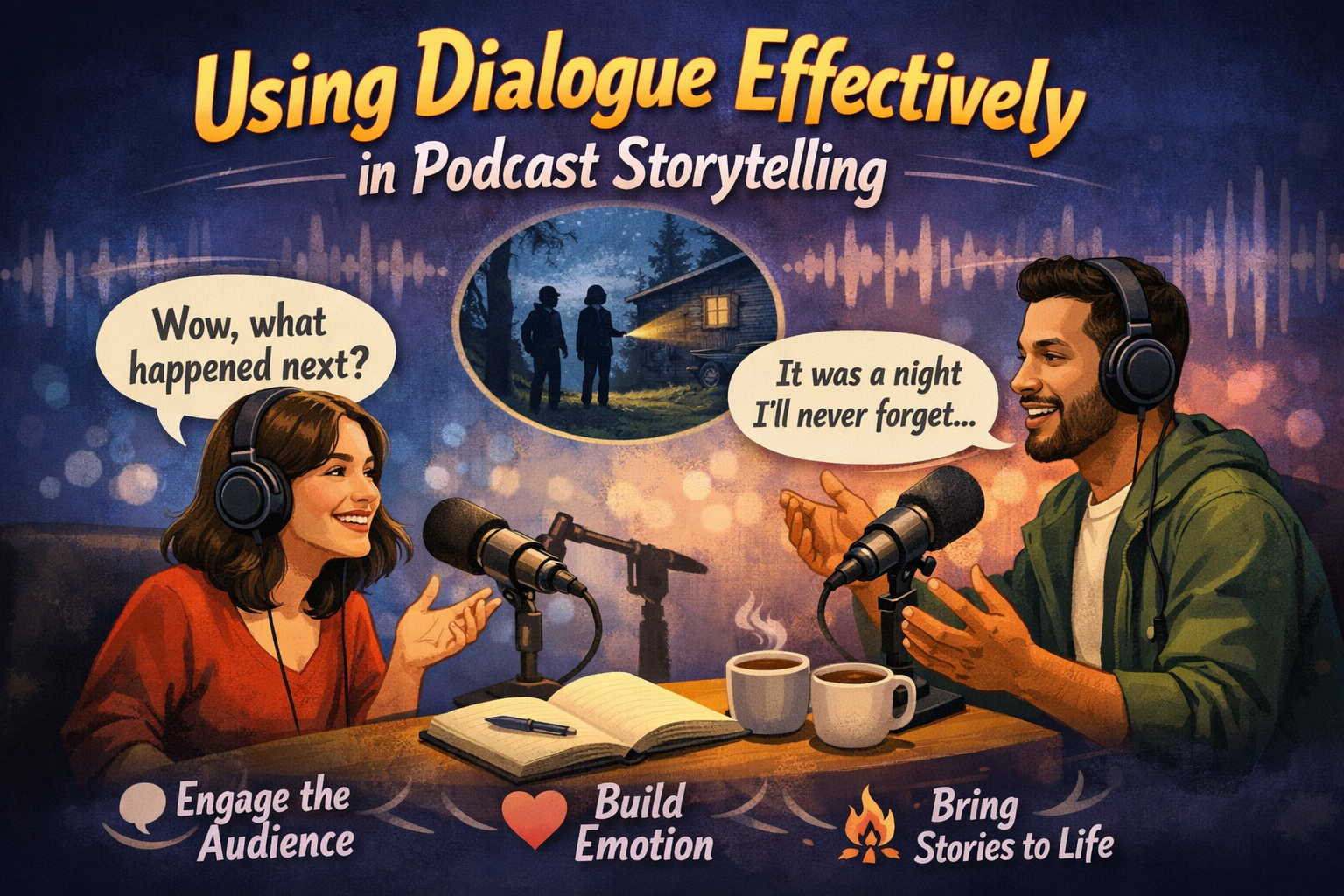
Dialogue is one of the most powerful tools in podcast storytelling. When used well, it brings scenes to life, reveals character, builds tension, and keeps listeners emotionally invested. When used poorly, it can feel forced, confusing, or distract from the story you’re trying to tell. Because podcasts rely entirely on sound, dialogue must do more than just convey information—it must carry the story.
Below, you’ll learn how to use dialogue effectively in podcasts, whether you’re producing narrative nonfiction, fiction, interviews, or branded storytelling.
Why Dialogue Matters So Much in Podcasts
Unlike written articles or videos, podcasts don’t have visuals to support the story. Listeners can’t see facial expressions, gestures, or scenery. Dialogue fills that gap by:
- Creating intimacy and emotional connection
- Revealing personality, tone, and motivation
- Moving the story forward naturally
- Making complex topics easier to understand
Well-crafted dialogue helps listeners feel like they’re inside the moment, not just hearing about it.
Dialogue vs. Narration: Finding the Right Balance
One of the most common mistakes in podcast storytelling is relying too heavily on narration while underusing dialogue.
Narration is great for:
- Providing context
- Explaining timelines or background
- Bridging scenes
Dialogue is best for:
- Showing conflict
- Revealing emotions
- Demonstrating change
- Making scenes memorable
A strong podcast blends both. Use narration to guide the listener, then let dialogue do the emotional work.
Make Dialogue Sound Natural, Not Scripted
Podcast dialogue should sound like real speech, not written prose read aloud.
To achieve this:
- Use contractions (“I’m,” “we’re,” “it’s”)
- Allow pauses, interruptions, and unfinished thoughts
- Avoid overly formal language
- Keep sentences short and conversational
If you’re scripting dialogue, read it out loud during editing. If it sounds unnatural when spoken, listeners will notice.
Every Line Should Serve a Purpose
Effective dialogue is intentional. Each line should do at least one of the following:
- Move the story forward
- Reveal character or perspective
- Create tension or curiosity
- Clarify stakes
If a line doesn’t add value, cut it. In audio storytelling, unnecessary dialogue slows pacing and loses attention.
Use Dialogue to Show, Not Tell
Instead of telling the audience what happened, let dialogue show it.
Less effective:
“It was a difficult moment, and everyone felt nervous.”
More effective:
“Are you sure this is going to work?”
“No—but we don’t have another option.”
This approach allows listeners to feel the emotion rather than being told what to feel.
Capture Authentic Voices in Interviews
In interview-based podcasts, authenticity is everything. Don’t over-edit dialogue to the point where it loses its natural rhythm.
Tips for better interview dialogue:
- Ask open-ended questions
- Let silence work—don’t rush to fill gaps
- Allow guests to speak in their own words
- Avoid interrupting emotional moments
Sometimes the most powerful lines are unscripted, imperfect, and raw.
Use Dialogue to Create Scene and Place
Because listeners can’t see the environment, dialogue must help establish it.
You can do this by:
- Referencing sounds, locations, or actions in speech
- Including brief reactions (“Did you hear that?”)
- Letting characters comment naturally on their surroundings
Combined with ambient sound or music, dialogue helps build a vivid mental picture.
Pacing: Keep Dialogue Moving
Podcast listeners are quick to disengage if a scene drags. Keep dialogue tight and focused.
Ways to improve pacing:
- Cut repetitive statements
- Remove filler words when they don’t add realism
- Alternate between short and long responses
- Break long conversations with narration or sound design
Good pacing keeps the listener curious about what comes next.
Use Silence as Part of Dialogue
Silence can be just as powerful as spoken words.
Strategic pauses can:
- Emphasize emotion
- Build suspense
- Allow listeners to process important moments
Don’t be afraid to let a beat breathe before the next line.
Editing Dialogue for Clarity
During post-production, your goal is clarity without losing authenticity.
Focus on:
- Removing distracting “ums” and “ahs” (but not all of them)
- Ensuring dialogue is easy to follow
- Keeping volume levels consistent
- Cutting anything that confuses the listener
Clear dialogue builds trust and keeps the audience engaged.
Common Dialogue Mistakes to Avoid
- Over-explaining information already clear from context
- Writing dialogue that sounds like an article
- Letting conversations go on too long
- Using too many voices without clear differentiation
- Ignoring emotional beats
Avoiding these mistakes will instantly improve the quality of your podcast storytelling.
Turning Dialogue Into a Storytelling Advantage
Great podcast dialogue doesn’t just deliver words—it delivers experience. It pulls listeners into the story, makes them care about the people involved, and keeps them listening until the end.
When you focus on authenticity, purpose, pacing, and emotion, dialogue becomes one of your strongest storytelling tools. Master it, and your podcast will feel more immersive, memorable, and professional.

Arthur Zani is a podcast storytelling enthusiast who helps beginner podcasters turn simple ideas into engaging audio stories. With a strong focus on clarity, emotion, and listener connection, they share practical tips and insights to help new creators build confidence, improve retention, and tell stories that truly resonate.